Dryland Design Teachings from the US Southwest

In the summer of 2021, I visited the Southwest United States after attending Earthship Academy at the Earthship Greater World Community, and was able to see in person many examples of sustainable dryland landscape design – something I had wanted to do since I began my journey into sustainable design in summer 2020. As someone deeply interested in the niche and underdeveloped topic of ecological landscaping design in the “Columbia” Plateau, I searched far and wide for resources that could help me understand how to design in a dryland-sensitive way in this unique ecosystem (see this link for my compiled resources).
Unfortunately, I found these resources scarce, but found a treasure-trove of resources on sustainable dryland design that were birthed from the rich ecosystems and cultures of the Southwest of the United States (and, above all, the Sonoran Desert). Of course, first among these are the books and other educational resources of Brad Lancaster, resident of Tucson, Arizona, which can be found at https://www.harvestingrainwater.com/. But I found plenty of other resources on dryland design, much more than from the Intermountain West, even though these lands are even drier than much of the Southwest and cover a vast expanse. All this led me to two questions – first, what can we learn from this region with a rich history and contemporary movement of sustainable dryland design? And second, why is the US Southwest (hereafter “the Southwest”) so far ahead of not just the “Columbia” Plateau but all of the dry Intermountain West?


As you can see from the above annual precipitation map, the area of drylands with annual precipitation less than 12” (orange and darker) extends far beyond the Southwest – which I would define as Arizona, New Mexico, as well as perhaps some of southern Utah and west Texas. In fact, the Great Basin is a much larger region than the Sonoran Desert, and also drier (according to the National Parks Service, the Great Basin is about twice the area of the Sonoran Desert – 200,000 vs 100,000 square miles2,3). Of course, the Great Basin itself is much larger than the “Columbia” Plateau and contains several large(r) cities (but has a lower population than the Sonoran Desert) – more on this at the end of this article. Despite the ecosystemic similarities – there are many plants within our small habitat that are also within the Great Basin, and the Great Basin doesn’t have the summer rain (AKA monsoon) pattern that the Sonoran Desert has – I have drawn more inspiration in my design from works and movements that originated in the Sonoran Desert and other parts of the Southwest.
Despite this, I would be remiss not to mention two very important resources for dryland design that both arose from Denver, Colorado – first, the concept of xeriscaping was invented by Denver Water4, and the Denver Botanical Garden is a great resource for dryland plant design. However, it should be noted that both of these examples focus more on plant science and plant selection with less of an emphasis on holistic ecological design (while I know that’s a broad statement to make, I think there is a real distinction there, and I hope to get into why I think this difference exists).
With that being said, what can we learn from the Southwest when it comes to dryland design? As it turns out, quite a lot, so this blog post will be far from comprehensive. Instead, I’ll touch on various examples I witnessed in my trip to the Southwest in 2021 as well as some other relevant examples I’ve heard of but not visited, with the overall goal of encouraging anyone interested in sustainable design in the intermountain west to not only draw from the richness of our native habitats but to also find inspiration in designs from other regions – in this case, the Southwest. The practices we can draw inspiration from can be split into three categories – architecture, landscape, and policy.
Architecture
The Southwest is known as being one of the (if not the) regions of the USA with the most unique architectural style. This is due to the influences of both Indigenous Pueblo architecture and Spanish colonial architecture, which itself drew on Indigenous pueblo design strategies. However, the contemporary architecture style of the Southwest, known as the Santa Fe style, isn’t just the organic continuation of previous design precedents – it’s a carefully designed strategy to craft regional identity. Stewart Brand details this history in his seminal work How Buildings Learn.
The first influence of the Santa Fe style is Indigenous Pueblo design – the iconic “multi-story adobe and stone ‘apartment houses’ ”5. These buildings were designed with the ecology of the region in mind, something that is reflected in many aspects. Of course, the buildings are built with local materials such as adobe, stone, and timber6. These structures are then covered in plaster which is replaced every year to maintain longevity7. Adobe has thermal properties which contribute to temperature regulation in warm areas, keeping buildings cool in the day and warm in the night, and Burch et. al. notes that “the most significant reductions in energy during heating or cooling [in adobe buildings] were found in the summer cooling season”8. However, the material properties aren’t the only ecological properties of Pueblo architecture – Pueblo towns are oriented toward the south and southeast to receive the sun’s warmth9. This element of ecological architecture – solar orientation and thermal mass to keep buildings at a comfortable temperature – is also a major feature of Earthships10, ecological buildings which have several other notable features covered below.

When the Spanish began to colonize the Southwest, both cultures adopted architectural strategies from each other – Indigenous peoples of the Southwest adopted the spaniards’s fireplaces called fogones and outdoor ovens called hornos. The Spanish, for their part, began to orient their houses toward the south and southeast12. The Spanish also brought other strategies which helped to cool buildings and adjacent areas in the Southwest’s hot climate. Portales – “covered walkways in front of commercial buildings”13, known as arcades in English14, provide a cool space adjacent to buildings facing public streets15. Interior courtyards within Spanish colonial buildings provide shade and a relaxing spot for residents while cultivating cool air that can be invited into other parts of the house. Fountains or ponds within these courtyards can provide further cooling through evaporation.


When Yankees arrived, they added further adaptations to what would become the Santa Fe style, such as glass windows and milled lumber17.
So how did all of these overlapping styles and influences get grouped together into the Santa Fe style? Brand states that, in 1912, Santa Fe was facing population decline, and saw tourism as their only hope18. The Santa Fe Planning Board decided to concoct a “Santa Fe style” to portray the town’s history through architecture19. Archaeologist Jesse Nusbaum and artist Carlos Vierra captured photos of pueblo and Spanish buildings and display them in an exhibition20. This effort inspired new construction and renovations in the new Santa Fe style, which drew on these older influences21. However, these new buildings rarely relied on the traditional materials that held much of their ecological value – instead, they were often made from “stucco on brick or wood frame”22. Buildings in this style sometimes reach parody, becoming bizarre facsimiles of the beautiful vernacular traditions they draw upon.


Despite the prevalence of cheap copies of this style, we can still learn a lot from the story of the Santa Fe aesthetic. A unique and identifiable regional style can help a region to stand out within a nation where a Nowhere, USA style predominates – where houses and neighborhoods can be difficult to tell apart despite thousands of miles of distance and distinct ecological conditions. This can provide a big boost to tourism -in 1992, readers of Conde Nast Traveler ranked Santa Fe best travel destination in the world24. In Brand’s words, “commercializing vernacular had turned adobe to gold”25. However, the creation of a hyper-local aesthetic also helps connect residents with their region’s ecology, culture, and history, and helps people to feel truly part of their place, rather than floating untethered through the world.
Inspiring architecture with ecological features in the US Southwest doesn’t start and end with the Santa Fe style. Pergolas and trellises attached to houses can create cool zones next to houses, either within courtyards or in other areas, and also protect the house from direct sunlight, reducing temperatures. The trellis detail I created, which is based on Brad Lancaster’s design, can provide more information on this concept.

Such practices are not only feasible for residential houses – they can help cool multi-story buildings as well, as proven by the massive pergola growing wild grapes on the CAPLA East building at the University of Arizona in Tucson.


Three other architectural practices with ample precedents in the Southwest are rainwater harvesting in tanks, composting toilets, and greywater systems. All of these practices are supported by more lenient policies, and, in some cases, grants for implementing these systems (see the policy section below for more detail).
Rainwater harvesting in tanks is a fairly easy concept to understand, but involves a fair bit of technological knowledge (which I lack) to implement, especially when harvesting in large quantities and using said water for indoor uses. When walking around the neighborhood of Dunbar-Spring in Tucson, Arizona (the epicenter of the rainwater-harvesting landscape projects fomented and implemented by Brad Lancaster and fellow Tucson residents) I saw several rain barrels, something I have only seen a few times in Eastern Washington, and never with cisterns this large. I also saw rain barrels in other projects I visited in the region.


Of course, another reference for rainwater harvesting that comes from the Southwest is Earthships, off-grid houses made primarily with reused and natural materials. Their rainwater-harvesting systems are quite developed, and the practical information found in Earthship originator Michael Reynold’s book Water From the Sky is a very useful source for those planning similar systems. Since Earthships are off-grid, they are designed to rely entirely on rainwater for all the needs of the house, including drinking, bathing, washing dishes, and flushing the toilet. Much of this water is reused in order to maximize its use. While Earthships were originated in a very dry region (the plateau outside of Taos, New Mexico where the Earthship Greater World Community is sited receives 8” of rainfall a year on average26), our region is drier still, with 6” of rainfall on average27. Nevertheless, I still believe it is possible to live entirely on rainfall in our region with slightly more capture and use reduction, although it likely wouldn’t be feasible in higher-density building typologies.


Another ecological design practice that Michael Reynolds and the Earthship concept have contributed to is greywater (used water from household sinks and showers) systems. Earthships reuse greywater from showers and bathroom sinks to water indoor plants, which also helps to filter the greywater. This water is then used to flush toilets (kitchen sink greywater is known as dark greywater and, in these systems, is sent straight to the blackwater tanks). Blackwater is sent to septic tanks with plants planted above to use the water one last time.


Michael Reynolds’s efforts with Earthships have helped to prove the viability of ecological design practices such as those listed above and develop policy more amenable to these systems. However, in part due to the restrictive policies around composting toilets (which are, in some ways, well-founded due to disease risks from untreated human waste or ‘humanure’), Earthship systems use conventional toilets flushed with greywater, not composting toilet systems.

Despite this, other ecological design practitioners such as David Omick have helped to develop functional composting toilets in the Southwest, as well as shift policy (more on this in the policy section). These practices have then been adopted by collaborators, such as Brad Lancaster. However, I wouldn’t say the Southwest stands out in the development of compost toilets as it does in the other architectural practices I’ve mentioned.
Greywater is another ecological design strategy with special relevance to drylands whose development was aided by design practitioners in the Southwest, although with other important influences from other regions in the USA. Art Ludwig’s (author of Creating an Oasis with Greywater) work in California is of special note – he helped to develop greywater systems which Brad Lancaster has used, developed further, and spread through his books, talks, etc. (learn more at oasisdesign.net).
Landscape
Greywater provides the perfect link between architectural systems and landscape design practices, as greywater reuse often brings water used within the home out into the landscape to benefit plants. This practice is a major part of the abundance of Brad Lancaster’s living laboratory, nourishing non-native perennial fruits and vegetables.
However, Brad Lancaster is more known for developing and propagating rainwater harvesting in streetside basins, a practice that has influenced my landscape design work significantly.

These designs can be combined with structures such as chicanes (see photo at very top) and traffic circles to calm traffic and shade hot hardscaped surfaces.

Brad Lancaster’s advocacy has led to drastic policy shifts around this practice in Tucson, Arizona – when he started, he broke Tucson law to build rainwater-harvesting basins, but now you can receive subsidies for it32. These policies also serve as great references to show to skeptical governmental officials to encourage propagation of these methods in our region.
Rainwater harvesting in the Southwest has a history that far predates the work of Brad Lancaster and other permaculture-inspired practitioners. Joel Glanzberg writes about Indigenous water-harvesting traditions in the desert southwest in Permaculture Drylands Journal, covering a variety of strategies such as check dams – small rock dams that hold water and soil from ephemeral flows to sustain crops – and floodwater farming, where water is diverted from arroyos to water adjacent fields33. One strategy, waffle gardens, mirrors rainwater-harvesting basins or rain gardens. Waffle gardens are “sunken beds with ground-level berms, or ground-level beds surrounded by raised berms of earth” which catch and retain rainwater as well as water added by hand-irrigation34. The most well-known waffle gardens were created by the Zuni people35 (Glanzberg pg. 173), a strategy which Julia Watson highlights in her book Lo-TEK: Design by Radical Indigenism. Watson notes that while large-scale waffle gardens are no longer in use by the Zuni, Zuni people still make waffle gardens at private residences36. While agricultural techniques such as those mentioned above are largely outside of my purview, the article by Glanzberg cited above provides a useful overview.
Although shade structures can be connected to buildings, they can also provide much-needed shade as standalone structures. Stand-alone shade structures have a long history in the Southwest, dating before Spanish colonization. Spanish settlers called these structures ramadas37, although they are known in the O’odham language (spoken by the Akimel, Hia C-ed, and Tohono O’odham peoples) as wa:ato (pronounced WAH-a-to)38. These structures are traditionally made entirely from native plant materials – a frame of mesquite logs with ocotillo branches filling in the gaps, tied together by rope made from agave or yucca fibers39.

Wa:ato are used to host a variety of outdoor uses such as markets or social events, serve as an outdoor extension of a home (known as a ki in O’odham), and are used as shelters during seasonal harvesting journeys40. Indigenous peoples of the Southwest continue to build wa:ato today41. For more information, I recommend this NPS article, from which this information is gathered.
The term “ramada” today refers not only to wooden structures resembling the wa:ato but also structures made from other materials such as concrete and metal42 that serve the same purpose – providing shade in a brutal summer climate. The ramada is yet another instance of an Indigenous technology in the southwest being adapted into the vernacular architecture of settlers and becoming part of the regional aesthetic.


Shadecloth can also provide much-needed shade in hot environments.


Trellises that stretch over paths expand growing space while shading hot hard surfaces.


Beyond discrete design strategies that can be adapted to local materials and contexts in our region, the Southwest provides an abundance of plants that can be integrated into our ornamental landscapes. While of course I prioritize native plants in planting design, I find some benefit in integrating native plants of the Southwest to bring more of a “desert” look to a design through agaves and cacti. Also, some Southwest native plants have edible and other useful properties that can be explored in our context as well, such as Agave parryi, whose heart can be roasted for food and whose leaves can be processed for fiber43! The Phoenix Desert Botanical Garden displays an incredible range of beautiful Southwest native plants.


Although many plants native to the Southwest cannot survive our cold winters, a broad selection of cold-hardy cacti can be found at https://coldhardycactus.com/. Our very own Tapteal Native Plants also carries some plants native to the American Southwest, such as the lovely small tree desert willow (Chilopsis linearis) and the small spiny false red yucca (Hesperaloe parviflora), which sports beautiful red blooms in the summer. Of course, all the plants carried by Tapteal Native Plants can survive in our environment, although some may need some supplemental water.
However, there is something plant-related we can learn from the Southwest that can’t be brought over as easily as a quick online payment for a cactus pad. When I visited the Southwest, I was immediately struck by how widespread native plants were, both in residential landscapes and in public landscapes like between highway lanes or next to sidewalks. Policy plays a major role in this difference.

Policy and Incentive Programs
Arizona’s native plant law is known to provide strong protections for native plants44 (although I was unable to find a comparison with other US states’ laws on this issue). This law provides a set process landowners must follow when removing native plants from their property. This law creates four Protected Native Plant Categories – Highly Safeguarded, Salvage Restricted, Salvage Assessed, and Harvest Restricted. Highly Safeguarded plants are threatened, and damage to the plants as well as harvesting plant parts are restricted45. For example, saguaros are Highly Safeguarded46 – it is illegal to harm them and a permit is needed to move or destroy them47. This legal barrier contributes to the abundance of this iconic plant not only in wildlands but also in residential neighborhoods, and similar protections exist for other native plant species in the region as well.
A 2013 study in Environmental Law Reporter also found that Arizona is one of the states with the highest spending on threatened and endangered species – state #5 with $3.3 million, although all states are far outranked by Washington with $32 million48.
The states fed by the Colorado River – Colorado, New Mexico, Utah, Wyoming, Arizona, California, and Nevada49 – have long been aware of water crises due to the long-standing over-use of water from the Colorado River. The Colorado River has been considered to be in “megadrought” since 200050. This often leads to water restrictions, such as the Stage 1 Drought declared in Denver, Colorado in March of 2026, which mandates water use only two days a week on set days51. These sorts of restrictions encourage homeowners and other land managers to switch to drought-tolerant landscaping to avoid dead or suffering plants in these conditions. Major cities within the Colorado River Basin have also adopted a broad range of education and rebate programs to encourage homeowners to switch to drought-tolerant landscaping52. Over the last 20-30 years, many large cities in the Colorado River Basin have reduced per-capita water use, and Salt Lake City and Phoenix have both reduced total use53. Denver, Salt Lake City, Phoenix, and Tucson have information and workshops available to residents to encourage conversions to xeriscaping54, much like the “Columbia” Plateau’s Heritage Garden Program. Some cities such as Albuquerque provide rebates for landscape conversions as well55.
A variety of cities in the Southwest also provide programs to encourage rainwater harvesting in barrels, also known as active harvesting. Tucson offers rebates to city users for both active and passive rainwater harvesting (retention in the landscape – more on this later), while Albuquerque and Santa Fe reimburse water customers for rainwater catchments56. Salt Lake City also sells rain barrels at cost57. The Rainwater Harvesting Tool (a project of the Pacific Northwest National Laboratory (PNNL) and the Federal Energy Management Program (FEMP)) shows that Washington State, along with almost all Southwest states, has state regulations on and incentives for active rainwater harvesting.
The evolution of policy regarding passive rainwater harvesting in Tucson, Arizona is a valuable case study. The legal frameworks and state support for passive rainwater harvesting in Tucson owes much to the efforts of Brad Lancaster. Brad Lancaster began harvesting rainwater on his property by illegally cutting the street curb, but now this process is legal and costs $152 for a permit58. However, Tucson now offers a $2,000 rebate for rain gardens (to read more about this program, follow this link)! This shows how a combination of do-it-ourselves action and consistent and dedicated public advocacy can completely transform the norm in a city. Not only are these practices encouraged for residents, Tucson’s Green Streets Policy “requires new and reconstructed roadways be designed to harvest the first 1/2 inch (13 mm) of rainfall in order to grow streetside and median vegetation”59. These policies and workshop and incentive programs in Tucson provide great examples to show skeptical city officials what is possible.
Reuse of household greywater is another water-conservation practice that many cities in the Southwest encourage. Santa Fe and Tucson offer rebates for installation of greywater systems, and Tucson requires new residential construction to “configure plumbing to allow for the installation of a gray water system in the future”60. In comparison, Washington State allows greywater use only for subsurface irrigation61, a method that is much more infrastructure-intensive and costly than above-ground irrigation.
Brad Lancaster details in a blog post how Utah residents Ros Brain McCann and Jeffrey Adams advocated to change Utah’s similarly-restrictive law to allow above-ground greywater systems. The previous rules required a $350 greywater permit and systems with surge tanks and pumps, but the new rules require just $100 for a permit and allow the release of greywater right into vegetated basins via gravity62. However, Utah law is still behind Arizona, which in 2001 became the first state to allow tank-less, gravity-fed greywater systems, has a no-cost permit, and allows kitchen sink dark greywater to be used as well63. Arizona law became so easy to navigate due to a study conducted by the Water Conservation Alliance of Southern Arizona, which found that more than one hundred thousand people were reusing greywater illegally due to the onerous nature of the previous permitting process64. The study also affirmed that greywater reuse “has a relatively low health risk if properly applied and managed”65. In response to this study, Arizona’s Department of Environmental Quality (ADEQ), the regulatory body responsible for greywater permitting, developed legislation that removed the need to submit a permit application but required thirteen best-management practices to be followed. In tandem with this low-barrier system, ADEQ focused on providing education to encourage healthy greywater reuse66. Inspired by this new framework, New Mexico adopted a similar permitting process in 200367. In this particular example, we can see how change in greywater permitting processes moved from Arizona to New Mexico, and then, through citizen advocacy, to Utah (as the precedent of similar legislation makes convincing regulators much easier).
Laws regarding composting toilets in the Southwest also provide helpful precedents for Washington State. David Omick was involved in the rewriting of the Arizona state regulations for composting toilets, and provides an overview of the concerns targeted by regulators68. In 2016, the Arizona Department of Environmental Quality approved both a 55-gallon barrel compost toilet system and a masonry chamber system69 – both systems are much cheaper and lower-tech than typical proprietary systems such as Clivus Multrum toilets70. Although public-domain compost toilet systems are legal in Washington, they must follow the criteria listed (which I believe the barrel system does) and require an installation permit71. This document reviews the legal situation in Washington State. While this legal framework is encouraging for these technologies here, the public education resources about such systems is not nearly as widespread as it is in Arizona.
The precedents above show that public advocacy and do-it-ourselves implementation and improvement of these strategies is essential to shifting policy and spreading ecological practices. Brad Lancaster and David Omick have written principles for policy change to guide similarly-minded change-makers in other areas (https://www.harvestingrainwater.com/2021/10/principles-for-changing-policy-that-allows-for-and-incentivizes-more-regenerative-practices/).
Despite the need for policy change to encourage some of these practices, I was surprised in this review to find less evidence than I expected of a clear-cut policy difference between Washington state and Southwest states regarding these practices. Although some cities in the region have outdoor water use restrictions, others do not, and only some cities provide rebates for drought-tolerant landscaping conversions. So, I come back to my second question – why is the Southwest so far ahead in dryland design than our region?
Conclusion: Why is the Southwest the Center of US Dryland Design?
Of course, an obvious reason would be population. Back to the Great Basin comparison, the two biggest metropolitan regions in the region are Salt Lake City with about 1.3M estimated residents (2025 data)72 and Reno with over 520,00073,74 (I’m not counting Las Vegas – with just under 2.4M estimated residents (2025 data)75 – because it is outside the Great Basin Desert76,77). In comparison, Phoenix and Tucson, the largest cities within the Sonoran Desert of the USA78,79, have metro area populations of over 5M80 and 1M81, respectively. Of course, the cities of the “Columbia” Plateau pale in comparison to both – the Tri-Cities metropolitan area with almost 325,000 residents82,83 and the Yakima metropolitan area with under 260,000 residents84 (as above, I have excluded Spokane from the map as it lies just outside the Columbia Plateau ecoregion as defined by the EPA – despite this, Spokane contains some of the best examples of regionally-appropriate design for the drylands of Eastern Washington).
However, the influence of Indigenous peoples has clearly had a strong role. The architecture section above highlights the many architectural strategies in the Southwest that have origins in Indigenous architecture. While Brad Lancaster was inspired by water-harvesting practitioners such as Zimbabwean Zephaniah Phiri Maseko85 and traditional rainwater harvesting techniques in India86, I can’t help but think that the prevalence of Indigenous rainwater-harvesting practices in the US Southwest has played some role in the prevalence of such practices today, although I have found little evidence of that outside of the continued work of Indigenous people such as Diné man Roberto Nutlouis87 and (at least partially) Indigenous-led organizations such as Native Seeds SEARCH88. While the Indigenous peoples of the “Columbia” plateau certainly have traditional practices to cope with the heat, their pre-colonization economy was not settled and agricultural but nomadic (with permanent villages in the winter) and based on hunting and gathering89. This lifestyle provides less precedents that can be adapted to the settled lifestyle we all live today, and a hybrid design style based on settlers’ adaptations of Indigenous methods like the Spanish colonial style of the Southwest did not take form in our region. As I have only begun to research this topic, there certainly may be further nuances here that I am missing.
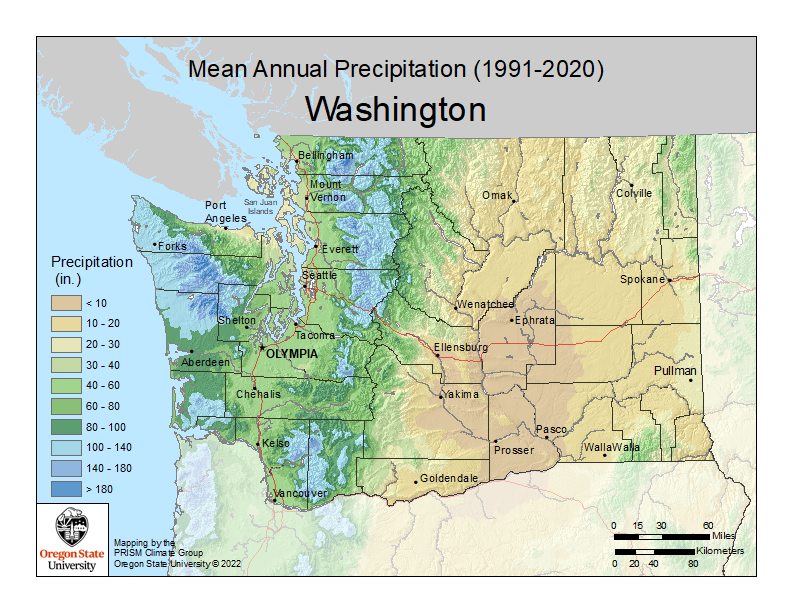
Another factor is in the cultural understanding of the region, something we can learn from in our region. The Southwest has a strong regional identity and understanding of itself as a dryland, as well as a more-widespread understanding of itself as undergoing a water crisis. Although the “Columbia” Basin has moderate-to-severe water limitation according to the USGS, rivaling much of the Southwest90, I do not get the sense that the majority of people in our region recognize this state of affairs. The abundant irrigation water that comes from west of the Cascades has led us to not see where we live as the dryland that it is (to the point that a middle-school classmate argued, with our teacher’s agreement, that we do not live in a desert, not because we actually live in an arid sagebrush steppe but due to the widespread availability of irrigation water). The major water scarcity problem we face in our region is the shifting timing of water availability due to the shift of precipitation in the Cascade Mountains from snow to rain. This change leads to greater water availability in the spring when it is less needed, and greater scarcity in the summer when it is most needed, as snowpack no longer exists to slowly provide water throughout the summer91. This crisis is clearly not widely understood – green lawns are ubiquitous, and only a few households and residential projects are beginning to install drought-tolerant landscaping, which unfortunately often takes the form of heat-batteries of basalt mulch piled over landscape fabric. Spokane does have a very inspiring drought-tolerant landscaping program which provides rebates and educational resources92, but Yakima and the Tri-Cities, which receive less than half of the annual rainfall of Spokane93,94, are very lacking in this regard.
Cultural understanding of the drought crisis is important, but ecological strategies grow from the reactions to this understanding. The eco-conscious/hippie culture – which emphasizes care for the Earth and learning from the Earth herself and Indigenous practices – has a strong presence in the Southwest, especially in Taos, New Mexico95, where the Earthship Greater World Community was founded by Michael Reynolds96. This culture combines with the understanding of the region as a dryland to cultivate more advocates who spread ecological design strategies and advocate for policy that encourages such practices.
Although I seek to understand the cultural and ecological conditions that foster the varying adoption of ecological practices, I don’t see these conditions as immutable. We must learn from these histories as a valuable precedent, and dive into our own local history and traditions to see what can be revitalized to foster ecological lifeways. We must grow a dryland culture that recognizes that the ecology of our region is defined by the scarcity of water. But this doesn’t mean replacing every lawn with a dead rockscape – instead, we can use the observation of natural habitats and varied cultural strategies to provide abundance for humans and other forms of life without undermining the water systems we rely on.
- PRISM Climate Group – PRISM 30-Year Normals ↩︎
- National Park Service – Sonoran Desert Network Ecosystems ↩︎
- National Park Service – The Great Basin ↩︎
- Denver Water – Xeriscape Plans ↩︎
- Brand, pg. 142 ↩︎
- Smith, Cassandra – Pueblo architecture and its relationship to place ↩︎
- Smith – Pueblo architecture and its relationship to place ↩︎
- Austin, George S. – Adobe as a building material, pg. 69 ↩︎
- Brand, pg. 142 ↩︎
- Earthship Biotecture – Thermal Mass – Heating & Cooling Buildings ↩︎
- Taos Pueblo Website Homepage ↩︎
- Brand, pg. 143 ↩︎
- Brand, pg. 143 ↩︎
- O’Malley, Therese – History of Early American Landscape Design, “Arcade” ↩︎
- Luo – Effects of tree characteristics and arcade design on the traffic pollutant dispersion inside the asymmetric street canyon ↩︎
- Tohono Chul – About ↩︎
- Brand, pg. 143 ↩︎
- Brand, pg. 146 ↩︎
- Brand, pg. 147 ↩︎
- Brand, pg. 147 ↩︎
- Brand, pg. 147 ↩︎
- Brand, pg. 147 ↩︎
- Google Earth 2026 at 3875 Cerrillos Rd, Santa Fe, NM 87507 ↩︎
- Brand, pg. 147 ↩︎
- Brand pg. 147 ↩︎
- Reynolds, pg. 29 ↩︎
- Washington Biodiversity – Columbia Plateau Ecoregion: Biodiversity ↩︎
- Reynolds, pg. 88 ↩︎
- Reynolds, pg. 111 ↩︎
- Reynolds, pg. 113 ↩︎
- Reynolds, pg. 115 ↩︎
- Lancaster, Brad – Water-Harvesting Financial Incentives & Tax Credits ↩︎
- Glanzberg, Joel – Water-Harvesting Traditions in the Desert Southwest, reprinted in Lancaster, Brad – Rainwater Harvesting for Drylands and Beyond Volume 1, pg. 173-176) ↩︎
- Glanzberg, pg. 173 ↩︎
- Glanzberg, pg. 173 ↩︎
- Watson, pg. 214 ↩︎
- Rossi, Vincent Nicholas – A Shelter By Any Name ↩︎
- Schnaubelt, Elizabeth and Sharlot Hart – Ramadas of the Southwest ↩︎
- Schnaubelt, & Hart – Ramadas of the Southwest ↩︎
- Schnaubelt, & Hart – Ramadas of the Southwest ↩︎
- Schnaubelt, & Hart – Ramadas of the Southwest ↩︎
- Wikipedia – Ramada (shelter) ↩︎
- Phoenix Desert Botanical Garden – Agave parryi sign ↩︎
- Thornton, Bill – Arizona’s Native Plant Law and Local Ordinances Help Save our Desert ↩︎
- McReynolds, Kim – Arizona Native Plant Law: What You Need to Know ↩︎
- McReynolds – Arizona Native Plant Law: What You Need to Know ↩︎
- Arizona-Sonora Desert Museum – Saguaro Cactus ↩︎
- Camacho et. al. – Assessing State Laws and Resources for Endangered Species Protection ↩︎
- Waterman, Stu – The US Southwest Megadrought Crisis ↩︎
- Waterman – The US Southwest Megadrought Crisis ↩︎
- TAP Staff – Denver Board of Water Commissioners declares Stage 1 drought, implements mandatory watering restrictions ↩︎
- Colby, Bonnie G. and Hannah Hansen – Colorado Basin Incentive-Based Urban Water Policies: Review and Evaluation ↩︎
- Colby & Hansen – Colorado Basin Incentive-Based Urban Water Policies: Review and Evaluation ↩︎
- Colby & Hansen – Colorado Basin Incentive-Based Urban Water Policies: Review and Evaluation ↩︎
- Colby & Hansen – Colorado Basin Incentive-Based Urban Water Policies: Review and Evaluation ↩︎
- Colby, Bonnie G. and Hannah Hansen – Colorado Basin Incentive-Based Urban Water Policies: Review and Evaluation ↩︎
- Colby, Bonnie G. and Hannah Hansen – Colorado Basin Incentive-Based Urban Water Policies: Review and Evaluation ↩︎
- Lancaster, Brad – Curb-Cut, Curb-Core, & Basin Creation Costs ↩︎
- Lancaster, Brad – Tucson, Arizona, Green Streets Policy ↩︎
- Colby & Hansen – Colorado Basin Incentive-Based Urban Water Policies: Review and Evaluation ↩︎
- Washington State Department of Health – Greywater Reuse ↩︎
- Lancaster – Simple & Effective Gravity-fed Greywater Harvesting Systems Legalized in Utah ↩︎
- Lancaster – Simple & Effective Gravity-fed Greywater Harvesting Systems Legalized in Utah ↩︎
- Lancaster, Brad – Rainwater Harvesting for Drylands and Beyond Volume 2, pg. 371 ↩︎
- Lancaster, pg. 371 ↩︎
- Lancaster, pg. 371 ↩︎
- Little, Val L. – New Mexico Gray Water Guide ↩︎
- Omick – Composting Toilet Regulations (And why most home-built composting toilets are non-permitted) ↩︎
- Watershed Management Group – Putting Human Waste to Work ↩︎
- Clivus Multrum – Foam-flush Toilet ↩︎
- Washington State Department of Health Office of Environmental Health & Safety Wastewater Management Section – Water Conserving On-Site Wastewater Treatment Systems Department Standards and Guidance ↩︎
- United States Census Bureau – QuickFacts Tooele County, Utah; Salt Lake County, Utah ↩︎
- Wikipedia – Reno Metropolitan Area ↩︎
- United Status Census Bureau – QuickFacts Carson City, Nevada; Washoe County, Nevada ↩︎
- Clark County Nevada – Clark County, Nevada 2025 Population Estimates ↩︎
- Wikipedia – Great Basin ↩︎
- EPA Level III Ecoregions. The ‘Central Basin and Range’ (#13) EPA Level III Ecoregion is the ‘Great Basin Desert’. ↩︎
- Encyclopedia Brittanica – Sonoran Desert ↩︎
- Wikipedia – Sonoran Desert ↩︎
- United States Census Bureau – Large Southern Cities Lead Nation in Population Growth ↩︎
- Population Review – Tucson Metro Area ↩︎
- Wikipedia – Tri-Cities Metropolitan Area ↩︎
- United States Census Bureau – QuickFacts Franklin County, Washington; Benton County, Washington ↩︎
- Census Report – Yakima, WA Metro Area ↩︎
- Gerfers, Trey – Our Water Matters ↩︎
- Robert Wood Johnson Foundation – The Gift of Water: How Communities Are Sharing Traditional Techniques to Combat Drought ↩︎
- Nargi, Lela – On Navajo Lands, Ancient Ways Are Restoring the Parched Earth ↩︎
- Johnson, Joel – Irrigated Dry Farming ↩︎
- Pauls, Elizabeth Prine and Brittanica Editors – Plateau Indian ↩︎
- USGS – Do We Have Enough Water? Yes, and No ↩︎
- Whittemore, Aaron – Implications of Shifting Timing in Water Availability in Eastern Washington ↩︎
- SpokaneCity – SpokaneScape Lawn Replacement Program ↩︎
- SpokaneCity – Geography ↩︎
- PRISM Climate Group – Washington Mean Annual Precipitation (1991-2020) ↩︎
- Keltz, Iris – Commune to Community ↩︎
- Boman, Sanna – In Taos, a community of ‘voluntary anarchists’ is taking off-the-grid living to the next level ↩︎