
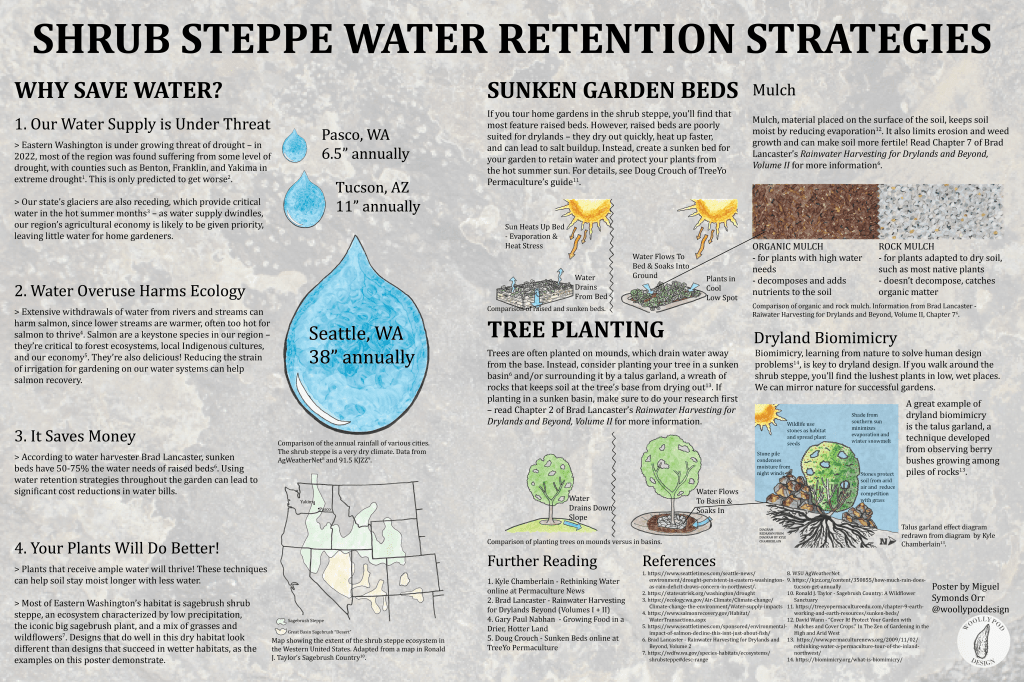
Shrub Steppe Water Retention Strategies
This poster is a resource designed to aid all who manage landscapes in shrub steppe habitats in implementing practices that will reduce water usage, saving money and growing resilient landscapes. Feel free to use this poster for your own (non-commercial) uses, as long as you credit me (Miguel Symonds Orr)!
Note: From my personal experience, talus garlands can sometimes burn adjacent plant leaves in summer due to the heat stone absorbs. However, I have also seen Ribes species grow in habitats much drier than they usually survive within talus garlands, so the benefits seem to outweigh the costs.
References:
https://statesatrisk.org/washington/drought
https://www.salmonrecovery.gov/Habitat/WaterTransactions.aspx
Brad Lancaster – Rainwater Harvesting for Drylands and Beyond, Volume 2
https://wdfw.wa.gov/species-habitats/ecosystems/shrubsteppe#desc-range
WSU AgWeatherNet
https://kjzz.org/content/350855/how-much-rain-does-tucson-get-annually
Ronald J. Taylor – Sagebrush Country: A Wildflower Sanctuary
https://treeyopermacultureedu.com/chapter-9-earth-working-and-earth-resources/sunken-beds/
David Wann – “Cover It! Protect Your Garden with Mulches and Cover Crops.” In The Zen of Gardening in the High and Arid West
[Highly Recommend] https://www.permaculturenews.org/2009/11/02/rethinking-water-a-permaculture-tour-of-the-inland-northwest/
Location: Shrub Steppe
Year: Spring 2022
Class: L ARCH 363: Ecological Design and Planning
 Woollypod Design