
Communion
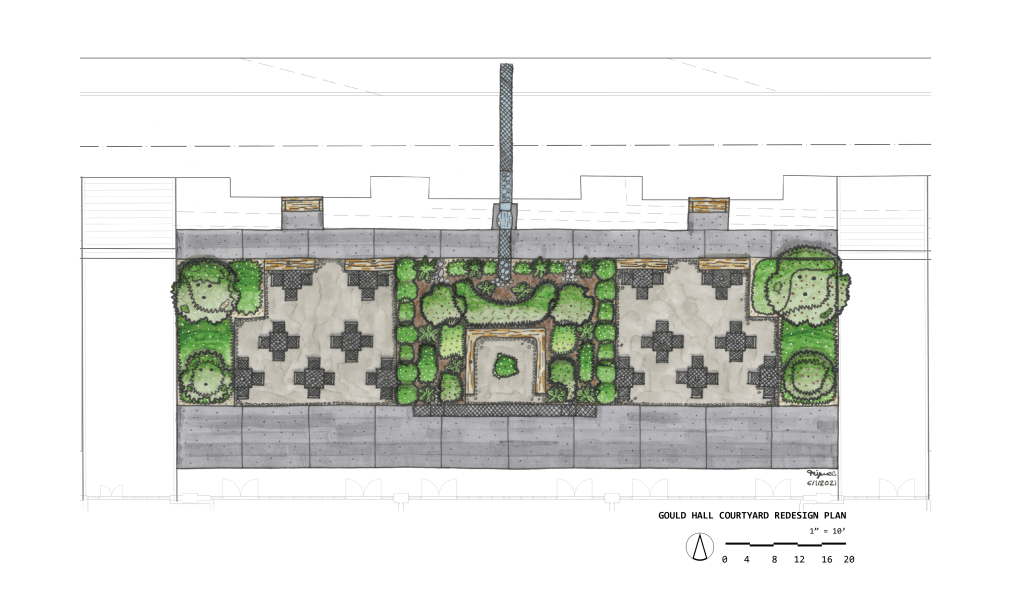
Communion reimagines the courtyard of Gould Hall, the home of University of Washington’s College of Built Environments (CBE). This landscape, at time of writing, is under-cared for and contains few aspects that would encourage interaction with the landscape. In my design, I aimed to work with the urban ecology by bringing runoff from the adjacent streetside to grow native plants in a rain garden. This would reduce the burden of runoff on Seattle’s sewage treatment system and provide habitat for native fauna along with visual interest for community members and passerby. I also added seating for CBE students wanting a break from long hours in the studio. I imagine a courtyard which could serve as an inspiration to all design community members and a place of respite from strenuous work and study. I look forward to future department projects that continue to transform this place!
Note: Creating a rain garden near the foundation of a building may pose flooding issues or damage foundations. I have seen rain gardens closer to buildings than this on the UW campus, but this is an important factor to consider when designing a rain garden.
Location: Seattle, Washington
Year: Spring 2021
Class: L ARCH 322: Intro to Design with Living Materials
Image Descriptions:
1: A marker render of a plan view of a courtyard. The courtyard consists of a central rain garden fed by a stream of street runoff. The courtyard surrounds an intimate gathering space consisting of a wrap-around bench with a central plant detail. On either side are seating areas with a ground surface of decomposed granite and movable chairs and tables. Planting beds with various short trees or tall shrubs are on the edges of the space, and beyond walkways stretch overhead. Walkways are on either side of the space, with benches cut into an existing wall on the northernmost side. To the south is Gould Hall; to the north is the adjacent sidewalk. The colors are somewhat dark.
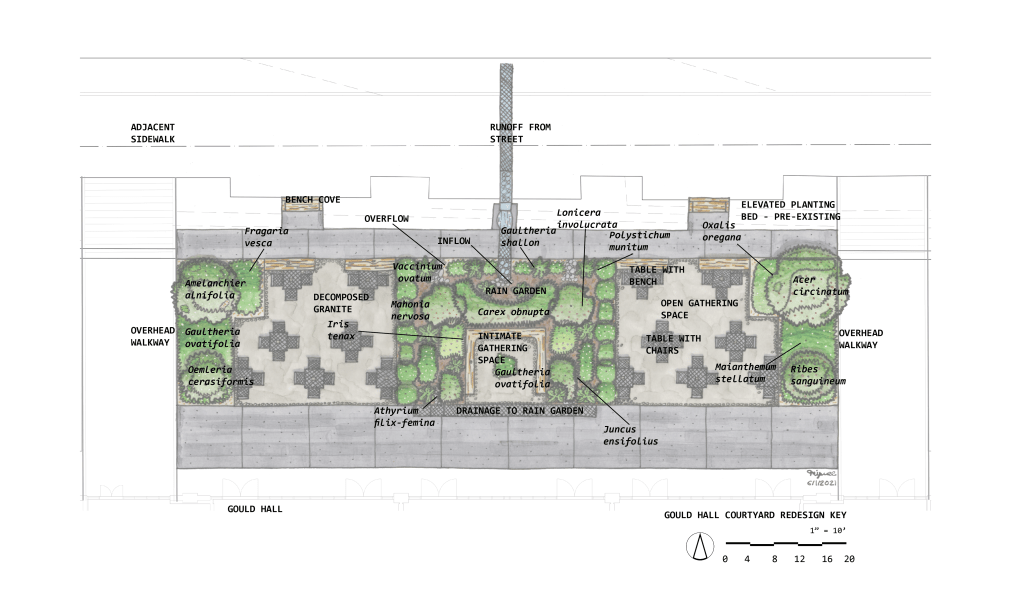
2: A key of the plants in the design and the various elements.
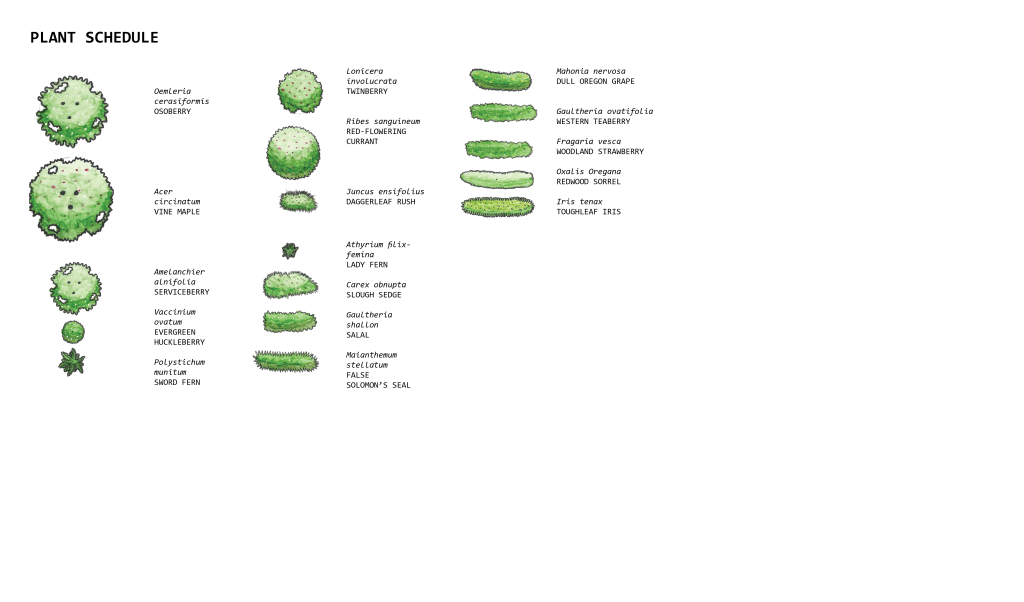
3: The planting schedule of the design. Plants are: Oemleria
cerasiformis/OSOBERRY, Acer circinatum/VINE MAPLE, Amelanchier alnifolia/SERVICEBERRY, Vaccinium ovatum/EVERGREEN HUCKLEBERRY, Polystichum munitum/SWORD FERN, Lonicera involucrata/TWINBERRY, Ribes sanguineum/RED-FLOWERING CURRANT, Juncus ensifolius/DAGGERLEAF RUSH, Athyrium filix-femina/LADY FERN, Carex obnupta/SLOUGH SEDGE, Gaultheria shallon/SALAL, Maianthemum stellatum/FALSE SOLOMON’S SEAL, Mahonia nervosa/DULL OREGON GRAPE, Gaultheria ovatifolia/WESTERN TEABERRY, Fragaria vesca/WOODLAND STRAWBERRY, Oxalis Oregana/REDWOOD SORREL, Iris tenax/TOUGHLEAF IRIS
 Woollypod Design