• A plan drawing made with pencil, watercolor pencil, and brown stains depicting a stream running beside trees and bushes. The stream comes out of two pipes at the edges of the drawing and meets in a larger stream in the center.
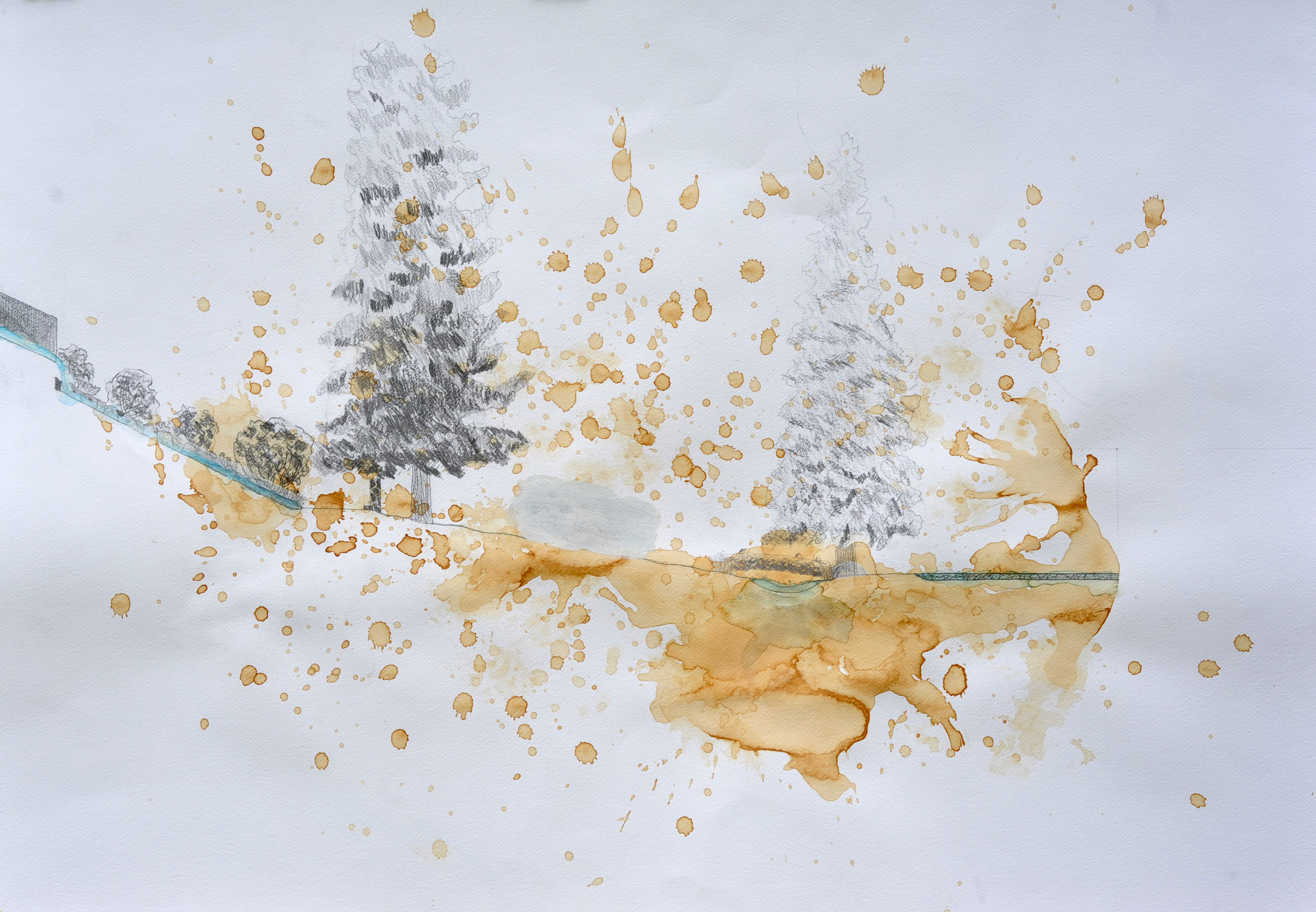
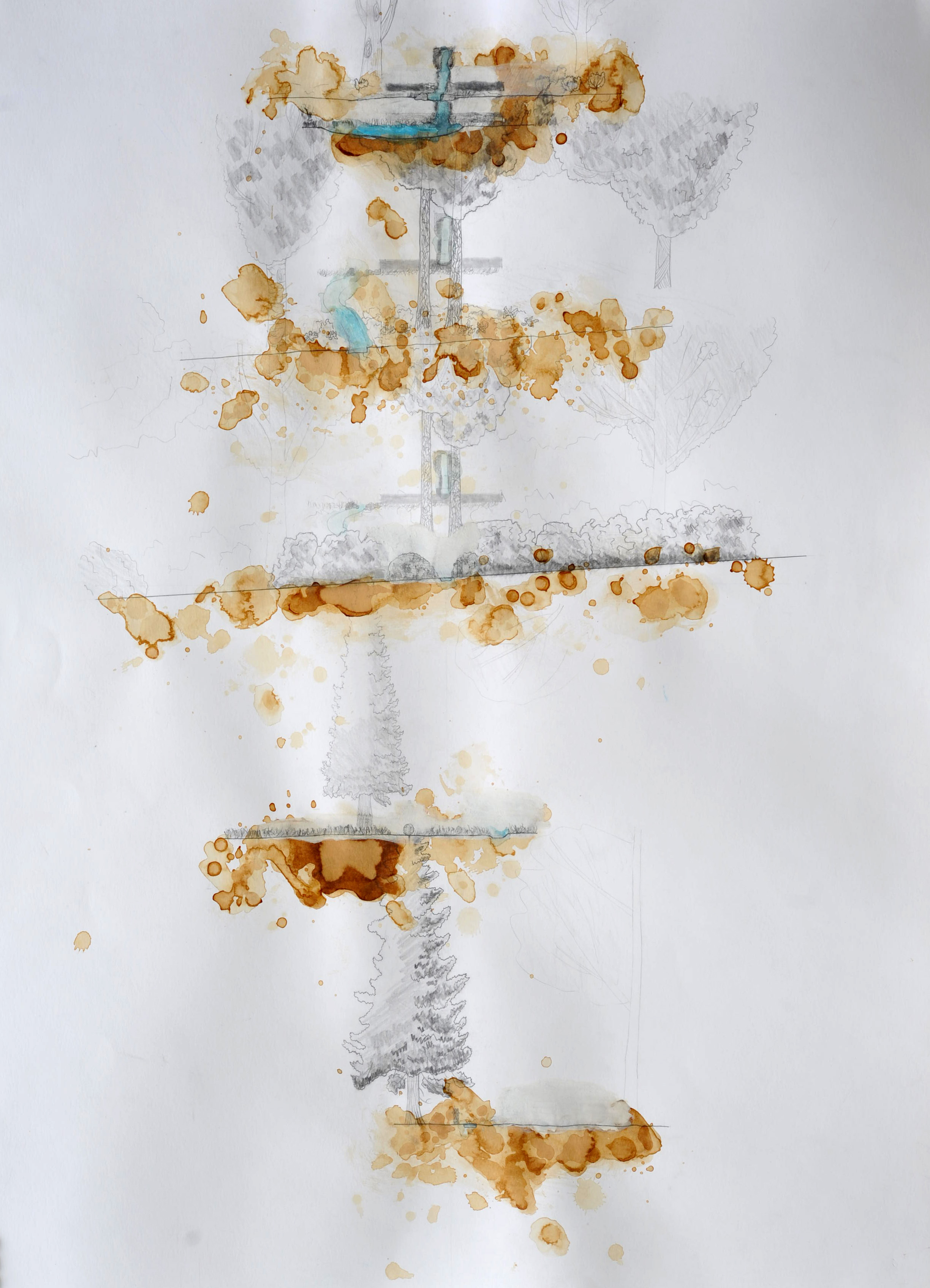
  • A section drawing made with watercolor pencil, and brown stains. From left to right, the drawing depicts a stream flowing out of a concrete pipe with vegetation in the background, a path, a water fountain, a large evergreen tree, a log over a stream, another evergreen tree, and more of the stream.
  • A series of sections along the transect. They depict different parts of the transect, all next to the stream along the transect. The transects go from a path nearby a stream to a wide open area to a steep slope with a pipe with stormwater flowing into a concrete rain garden and a pond.
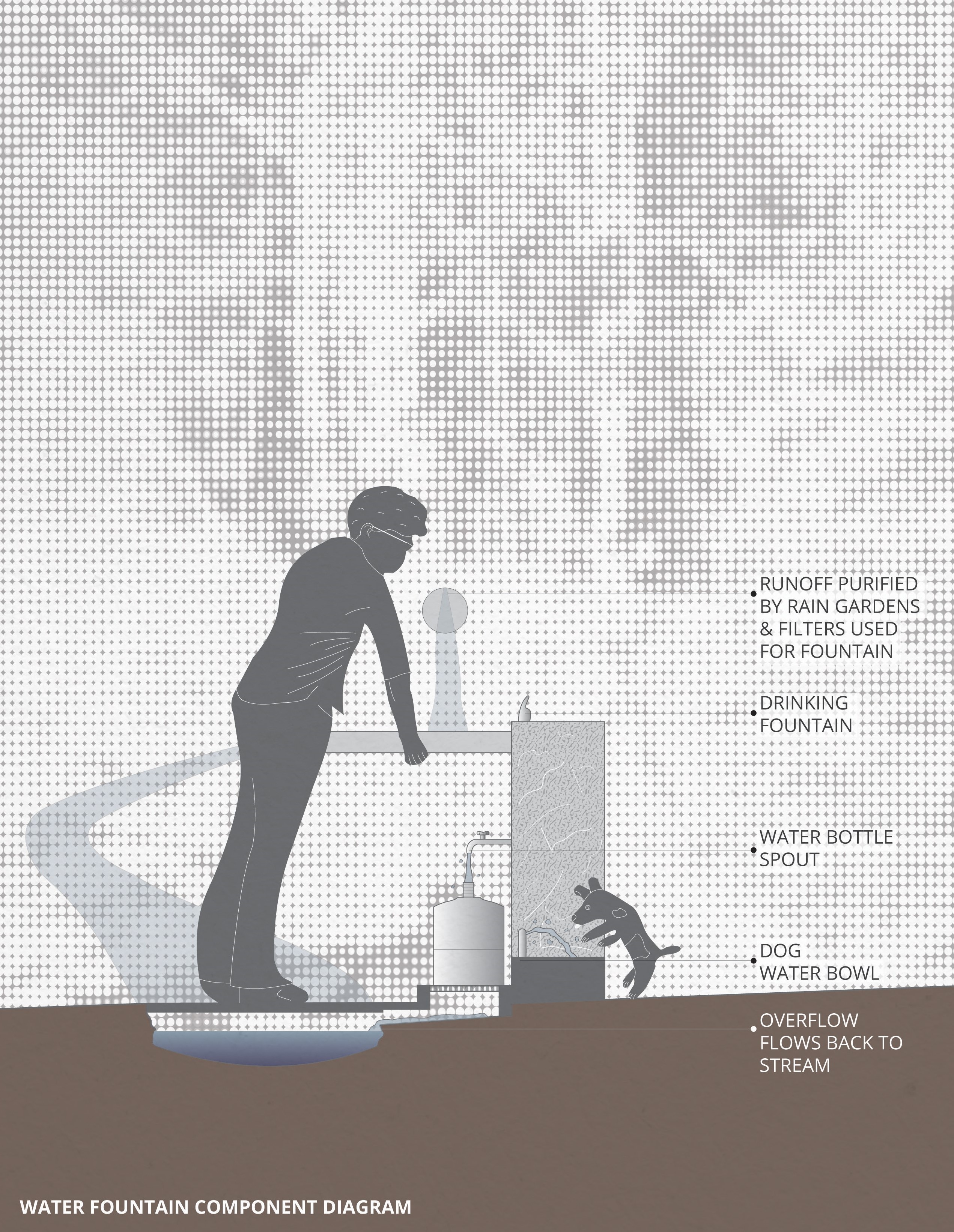
  • A section diagram depicting a water fountain with a stream in the background flowing toward the section cut. The water fountain overflow flows into the stream. The water fountain has labels for its different elements: "Drinking fountain", "water bottle spout", "dog water bowl." Labels at the top and bottom note that "runoff purified by rain gardens & filters used for fountain" and "overflow flows back to stream". The diagram has a forested background made of half-tone dots and is in a sleek style, made in Adobe Illustrator.
  • A diagram labeled "Intermittency Diagram". The diagram shows a scene with a culvert pipe, a concrete rain garden, and a pond in three conditions - "dry season", "wet season", and "during rain". In the dry season, the rain garden and pond have a little bit of water at the bottom. During the wet season, the pond and rain garden are almost full of water. During rain, the pond and rain garden are full, with water flowing from the culvert pipe to the rain garden and to the pond and out of the pond.
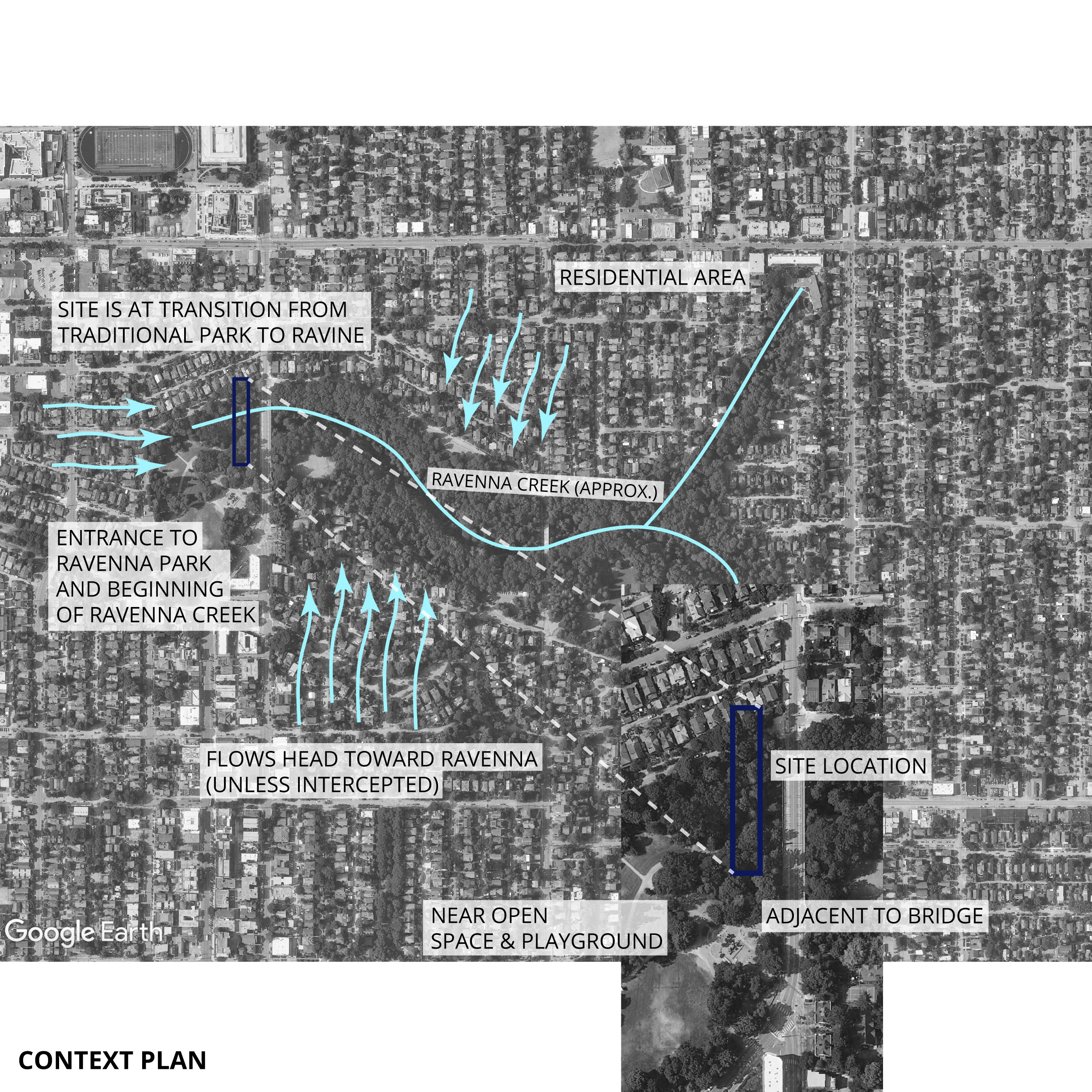
  • A diagram titled 'Context Plan'. The diagram has Google Earth aerial views of the area around Ravenna Park with labels. A light blue line bends about the creek, labeled "Ravenna Creek (Approx.)". Blue arrows flow to the creek from adjacent areas, labeled "flows head toward Ravenna (unless intercepted)." Other labels read: "residential area" north of Ravenna Park, "site is at transition from traditional park to ravine", "entrance to Ravenna Park and beginning of Ravenna Creek", "near open space & playground", and "adjacent to bridge". A rectangle on the map is connected to a larger rectangle of the same dimensions with a zoom-in of the aerial image. The larger rectangle is labeled "site location".
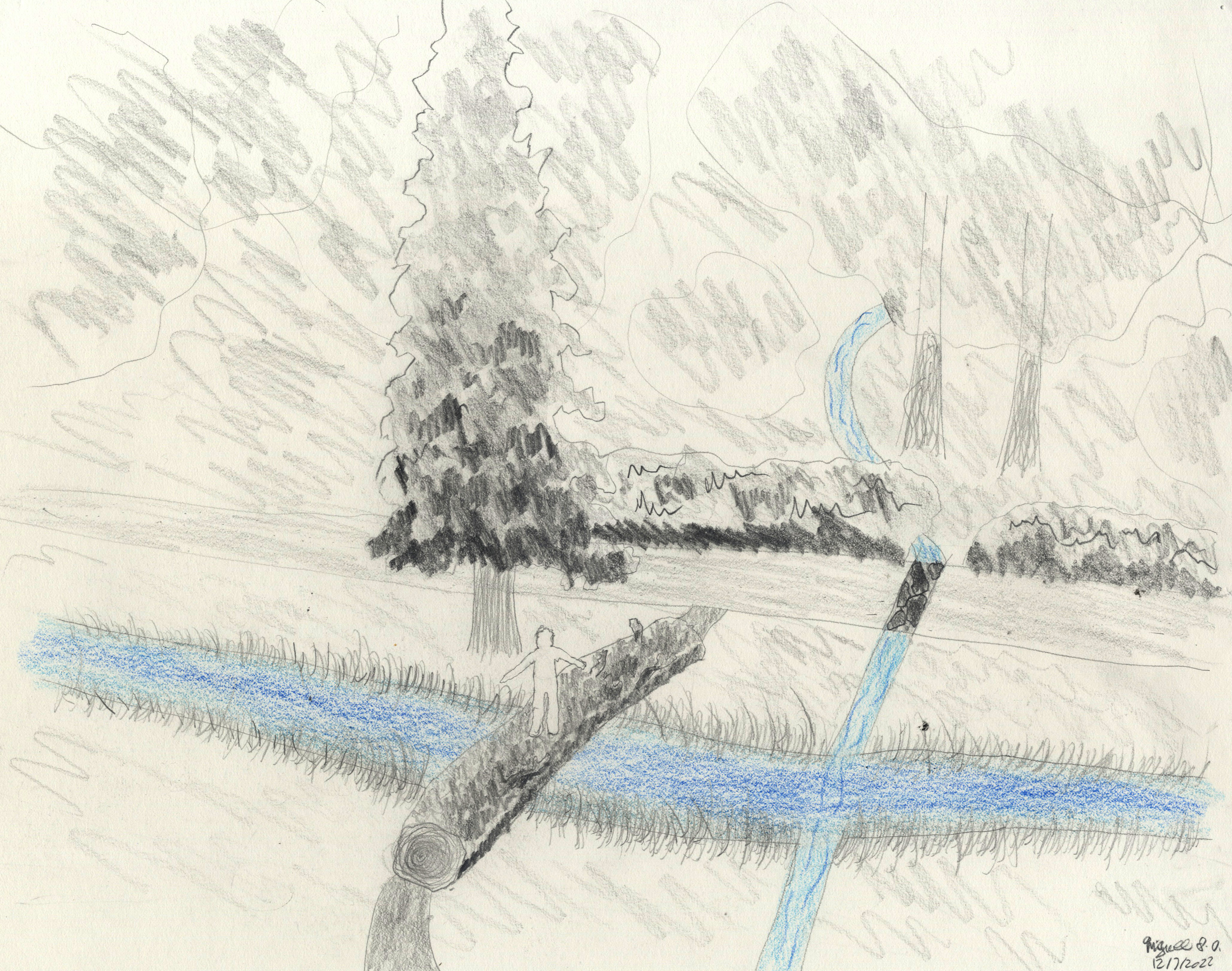
  • A perspective showing a blue stream with a child standing on a log over the stream. A thinner stream flows under a small stone overpass and over to the stream. An evergreen stream grows next to the log over the stream. Bushes and trees are in the background. The drawing is black and white pencil except for colored pencil for the water.
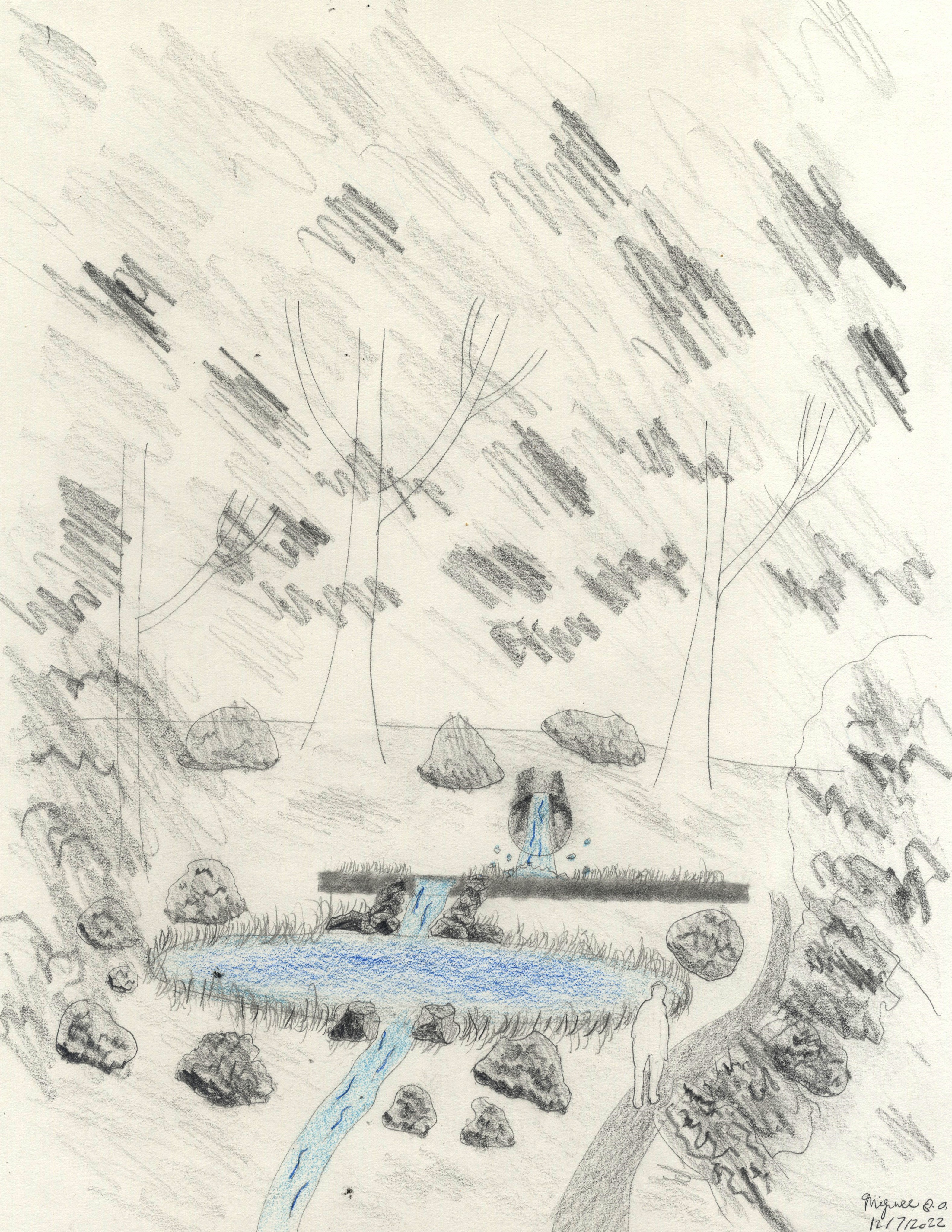
  • A perspective showing someone walking on a path beside a pond and a concrete rain garden with water pouring out of a culvert into it. Bushes and trees are around the scene and in the background. The drawing is in black and white pencil except for the water, which is drawn in blue colored pencil.
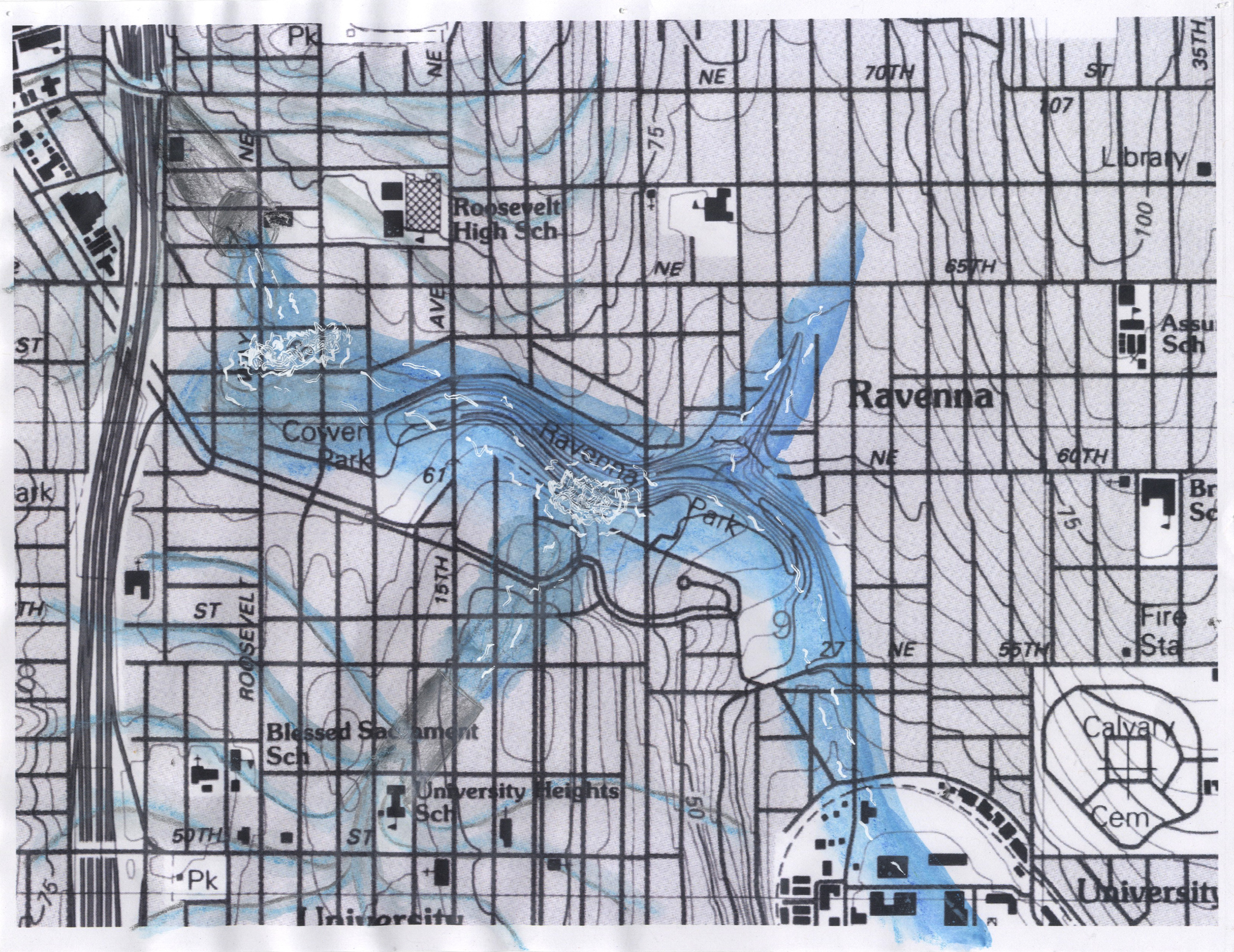
  • A printed map of the Ravenna area drawn area with watercolor pencil, pencil, and gel pen. A watercolor pencil stream stretches through Ravenna Park, and streams of water flow into culverts and dump into the creek in the center of Ravenna Park.
Reconnect

Reconnect reimagines a stretch of Ravenna Park by telling a story about the restoration of historic flows in urban areas. Inspired by what I learned about the history of Ravenna Creek, I decided to center water in my changes to the transect of Ravenna Park I was assigned in this studio project. Ravenna Creek has been cut off from Green Lake and shuttled underground to Union Bay, and the historic flows from the adjacent slopes have been shuttled to pipes underground, away from the creek. I decided to bring these overland flows back by piping stormwater runoff through filtering rain gardens and into the creek. By connecting this restored flow to drinking fountains, I illustrate how the health of our region’s waters is linked to our own health, and restoration of water is a critical step for the health of ecosystems of which we are a part. The location of this intervention near the transition from Cowen Park to the more forested ravine seeks to prompt reflection in visitors and provide for those leaving and entering the park.

The rain gardens on the south side of the transect (top right of the plan, first image) transition from a concrete-walled rain garden to a pond to purify the water, showing how greater disturbance and tainting of water often calls for greater interventions to undo ecological harms.

Location: Seattle, Washington

Year: Autumn 2022, Updated Summer 2024

Class: L ARCH 401: Design Foundations Studio

Medium: Plans & sections – pencil, staining, watercolor pencils. Concept plan and perspectives – pencil and watercolor pencils. Edited in Photoshop. Diagrams made in Adobe Suite.
  • A section diagram depicting a water fountain with a stream in the background flowing toward the section cut. The water fountain overflow flows into the stream. The water fountain has labels for its different elements: "Drinking fountain", "water bottle spout", "dog water bowl." Labels at the top and bottom note that "runoff purified by rain gardens & filters used for fountain" and "overflow flows back to stream". The diagram has a forested background made of half-tone dots and is in a sleek style, made in Adobe Illustrator.

Woollypod Design

Social Media

I practice design on the ancestral lands of the Plateau peoples or the Coast Salish peoples, who have stewarded these ecosystems since time immemorial.