
Book & Article Recommendations
Shrub Steppe Native Plant Design
Books:
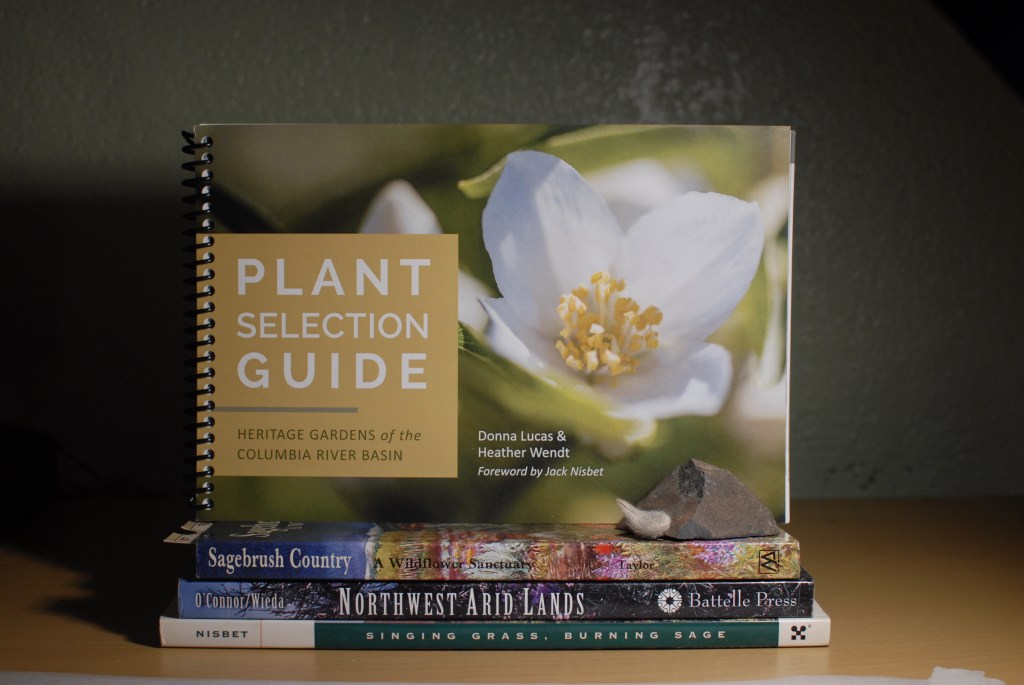
Donna Lucas & Heather Wendt – Plant Selection Guide for Heritage Gardens of the Columbia River Basin – must have. Shrub steppe native plants with photos and gardening tips
Ronald J. Taylor – Sagebrush Country: A Wildflower Sanctuary – must have. Shrub steppe plant descriptions with photos & invaluable lists of native plants by habitat
O’Connor & Wieda – Northwest Arid Lands – focuses more on native fauna and ecological conditions
Nisbet – Singing Grass, Burning Sage – a pleasant coffee table book with pretty pictures of the shrub steppe and historical tidbits
Other Resources:
WSU Master Gardener Program – Fire Resistant Plants for Eastern Washington – valuable for fire-safe design practices and plant selection
Kyle Chamberlain – Rethinking Water: A Permaculture Tour of the Inland Northwest – must read. One of the only resources I’ve seen examining shrub steppe ecology from a permaculture or systems-thinking perspective
“Columbia” Plateau Indigenous History/Culture Recommendations
Books:
Eugene S. Hunn, E. Thomas Morning Owl, Phillip E. Cash Cash, & Jennifer Karson Engum – Čaw Pawá Láakni = They Are Not Forgotten: Sahaptian Place Names Atlas of the Cayuse, Umatilla, and Walla Walla – must have for anyone living in this region. Contains a sizeable section on local Indigenous history and practices and an atlas full of Indigenous names and history of places throughout the region
Eugene S. Hunn with James Selam and Family – Nch’i-Wána/”The Big River”: Mid-Columbia Indians and Their Land – valuable anthropological study of Plateau peoples
Mink – From Taptat to Prosser Dam – interesting book about the local Indigenous history of Prosser, Washington’s dam and the Indigenous fishing sites around it, with a valuable history of regional Indigenous fishing rights battles
Other Resources:
Confluence – local history education with an Indigenous focus
Wanapum Heritage Center – very informational museum of local Wanapum Indigenous history
Dryland Design
Books:
Brad Lancaster – Rainwater Harvesting for Drylands and Beyond Volumes I & II – must have. Brad Lancaster sees urban ecosystems ecologically while valuing all that native plants have to offer. One of my most-used resources, especially Volume II
Gary Paul Nabhan – Growing Food in a Drier, Hotter Land – valuable guide, especially for vegetable gardening
Global Drylands Library – Curated by Michael Pilarski
Other Resources:
Rainwater Harvesting for Drylands and Beyond – very useful website and blog by Brad Lancaster with lots of rainwater harvesting information
Dunbar/Spring Neighborhood Foresters – inspiring model of community-led land care for an urban neighborhood
US EPA – Green Infrastructure in the Semi-Arid West
TreeYo Permaculture – https://treeyopermacultureedu.com/chapter-9-earth-working-and-earth-resources/sunken-beds/ – useful resource for constructing sunken garden beds in drylands
General Ecological Design
Rainier & West – Planting in a Post Wild World – book about designing beautiful native plant-centric gardens. Few gardens shown here have an aesthetic applicable to what occurs in the shrub steppe but the information is still quite useful
David Holmgren – RetroSuburbia (available online at a pay-what-you-feel rate) – in-depth book full of useful design strategies for resilient living in suburban settings in Built, Biological, and Behavioral spheres
Bill Mollison – Permaculture: A Designers’ Manual – expensive book but full of ecological design strategies, and a substantial chapter on drylands. It’s worth noting that permaculture has faced criticism from some Indigenous people due to its appropriation of Indigenous knowledge – here is one critique along those lines
James Urban – Up By Roots: Healthy Soils and Trees in the Built Environment – must-read guide on designing for successful trees in urban spaces – every office and city should own a copy. Very in-depth and practical yet easy to follow. However, Urban misses some of the value of native trees in my perspective. The book’s conclusions must be tempered with an understanding of how to grow healthy trees in a dryland environment and whatever trees are native to your region. It is also pricey and long.
Julia Watson – Lo-TEK – examples of Indigenous design around the globe showcased with beautiful photos and graphics
 Woollypod Design